Stranded

The buzzing sound wakes him, but only slightly. He is curled up on his left side, lying on the sandy floor in the furthest recess of a cave. It is not so deep, less than twenty feet overall. The inside of the cave is cool and dark nonetheless, despite the hot tropical sun outside. His face is pressed against the coarse sand on the cave floor. Sand is in his matted, singed hair. He is exhausted and the cave is cool and dark and he just wants to sleep.

Still, the buzzing persists. It gradually becomes louder. He groans and rolls onto his back. He coughs a rough, hacking cough. Grains of sand stay embedded in his cheek. His eyes remain closed. The buzz fades until it is faint, barely audible above the crunching of the sand as he rolls over some more onto his right side. He wonders what had happened overnight to put him in this deplorable mess.

The buzz fades but not completely before it starts to grow louder again. The sound of the buzzing becomes strangely soothing to him.

He falls back asleep.

But only for a moment.

When he awakes, the buzzing has already faded again. He hears it grow louder, close to the cave. Then it grows quieter.

He is exhausted and his body is aching all over from the night before. His mind is in a fog. The buzzing once again grows louder. He puzzles over it, eyes closed, dreamlike. It sounds vaguely mechanical to him. Mechanical and high above outside the cave. Again, it fades away from the cave. He puzzles some more.

Then his eyes pop open. He pushes himself up onto his knees and scrambles to his bare feet. A stabbing pain shoots through his back and he staggers for a moment. His head spins. He takes in a deep breath. His head stops spinning and starts to throb. The air is cool. It tastes of smoke. The sand still clings to his cheek.

He takes an uncertain step toward the opening of the cave. A hand against the cave wall helps to steady him. He takes another step, then another. Step by step he staggers to the opening.

Swirling smoke greets him at the mouth of the cave. The smoke burns his already painful eyes.

He steps out of the cave and looks about. After a pause, he tries to step around the smoke to survey the landscape and to scan the sky for the source of the buzzing. With his back against the rocks of the hill the cave is sunk into, he feels his way down the slope a distance. Hiding under an outcropping of rock, he closes his eyes. He remembers the night before and how this all happened.

What had happened was that he had made the decision that he had to get off the island. The island was too small. It was too small and he was not going to spend the rest of his life there and die there, alone. So he had to get off the island. He had to be rescued. It was his attempt to get off the island the past few days which had led him to this deplorable mess.

He winces as he thinks about it. About how lonely he was. How lonely and scared.

He had determined to get off the island somehow, some way, any way he could.

He remembered that much. The rest started to come to him.

Under the outcropping of rock, with his burning, teared eyes closed, he recounted how he formulated the plan to get off the island and how he planned and hoped and how he started to put the plan into effect.

First, he knew that making a raft and putting out to sea was not an option.

Not after what happened to Janet. He couldn’t make himself do it; he just couldn’t.

He could not get to safety. He would have to beckon his rescue to come to him.

So, desperately, he devised a plan. How to get someone’s attention so that they could come to the island and rescue him, that was the question.

Early on, the shape of the island had reminded him of a foot, a left foot with a shallow bay near the instep of the foot and a few caves just above the ankle, near the top of the island. One cave, the one he slept in, was tall enough to stand in and deep enough to escape rain or wind.

Or smoke.

Up from the cave, the highest point of the island rose a few hundred feet above the waves that lapped the shoreline. The highest point wasn’t really much of a point, more of a flat area at the top of the hill.

The slope down from there was steep at the ankle. Lower the slope was more gradual as the island flattened out near the shoreline.

The plan had not come to him all at once, complete. He had formulated it only after the failed attempt to raft away. However, once it started to form it grew quickly until he was satisfied it would work.

The plan would work. He just knew it would. It had to.

He intended to create a light, a beacon that would lead someone or something, a plane most likely, but also maybe a ship, whichever, to him and he would be rescued. He knew in his head that his chances were slim, but in his heart he felt it would all work out.

He decided that the highest point on the island would get him and his light, his beacon, seen for miles.

So he searched the island for dried, dead wood, which turned out to be not all that difficult. Although quite small, the island was hilly and had plenty of dead trees and shrubs. So many small trees had been levelled by the infrequent storms over the years, including the one that had brought him to the island. Broken, downed trees littered the island, just waiting to be burned.

So he started dragging logs and sticks and shrubs. He started with the driest he could find. Fat logs, skinny logs, whatever he could find, so long as they were the driest.

He was confident that if he made a big enough, bright enough light then some passing airliner or ship would see it and report it and rescue would be on its way.

So he started to build his pile. He was determined to make it big enough, to pile not just barely enough, but rather to pile way more than enough.

He set out to find the driest.

He found a small tree, dead and brittle. It had been growing a short way down the slope from the spot he had chosen for the fire. He grabbed the tree with both hands and leaned hard into it and it snapped just above the ground, causing him to lose his footing and almost fall on the jagged stump that was sticking out from the ground. He recovered his balance and grabbed the narrow trunk by the base and tugged it as he walked backward up the hill. When he made it to the crest of the hill he dropped the end of the trunk and brushed off his hands. A smile crept onto his face. The first log was done.

With that he felt a surge of energy within himself and quickly found another small trunk and then some brush and then more small trees.

The pile grew throughout the morning. Starting close to the top of the hill, he slowly worked his way down the slope, retrieving trunks and branches and brush from a bit further away on each trip. A path was being forged out of this work. After each trip down the hill he would pretty much retrace his steps back to the top.

With each trip, the slope to the top seemed to grow steeper and steeper. His early burst of energy started to wane and he felt the need to pace himself as the day went on.

He took a few breaks to rest or to search for fruit on one of the pandanus trees near the bottom of the hill for energy to keep going.

Late in the day he was hauling a stump he had worked loose. Exhausted, he stumbled several times up the slope to the fire spot. On one of these stumbles, he looked to the west and saw the sun about to sink below the horizon. He managed to get back on his feet and plod onward, dragging the stump behind him. Darkness was beginning to descend as he finished the journey up the hill. He was grateful for nightfall. It was obvious he needed rest.

After heaving the stump onto the pile, he turned from the pile and gathered some palm fronds and used them to make a bed. It would be a clear night. There was no reason to sleep in the cave he had found where he sought shelter from the storm that brought him to the island. Instead he would sleep by his pile and begin again in the morning.

A gentle breeze caressed him as he lay down on the leaves. His wavy brown hair, which had grown long, fluttered in the soothing wind. The unending sound of the waves on the shore eased him into a deep slumber.

Morning arrived. He awoke, hungry and thirsty. The sun was already fully risen and urged him to resume his work. Yet he knew that further wood-gathering would have to wait until he ate and drank.

Slowly, he eased himself to his feet. His body ached from all the dragging and pulling and lifting and carrying he had done the day before. His hands were rubbed raw. His muscles ached and his stomach rumbled.

The path he had worn through the dense growth the day before led him downward toward the water in a circuitous route that wove its way through the dense growth and eventually brought him out between the heel and the instep of the foot that was the island, ushering him onto the end of a beach near a reef. Shellfish made their home in the shallows of a protected pool close to shore.

The water was cool and inviting and made the harvesting of his breakfast a welcome relief from the hard work that occupied him the day before and which awaited him again. It did not take long to gather enough shellfish for a quick breakfast. When he was finished gathering, the shade of a large palm tree waited for him next to the flat rock he used as a table. Broken, empty shells littered the area, remnants of the meager meals he had eaten since being stranded. He used rocks on the shore to break open the shells. The meat inside was salty, sweet, and delicious.

As he worked at the shells he tried not to notice his own emaciated body. Finding shellfish and small bits of fruit was a daily struggle. It seemed to take almost as much energy to find food as the food gave him and that struggle showed itself in his protruding ribs.

When he finished the last of the shellfish he scrambled back to his feet and headed for the pandanus and the small pools of water near the base of the hill. Then he selected the next bit of tree and brush to haul up the slope to his wood pile.

This went on for three days, at the end of which he looked at his ragged heap of logs and sticks and brush and decided that he had enough wood. It was time.

Sunset was almost at hand, it would arrive in less than half an hour.
The canister with the matches was far too precious for him to carry about with him throughout the day. The canister was watertight, so there was no real danger of the matches being soaked. The real danger was losing the canister or having it fall out of his pants, which had become flimsy and tattered since he arrived on the island. The match canister had its own special niche inside the cave.

It was incredibly good fortune that even had the matches. When the boat went down, the matches were in his pocket, protected in their canister. He had forgotten to put them away the last time he used them and it was not until after he was on the island that he even realized he had them.

As the sun dropped down to the horizon, he shuffled down the hill to the mouth of the cave and then quickly retrieved the canister from its spot. Quickly but carefully, he returned to his wood pile.

He scanned the horizon, not really expecting to see a plane or hear one either. Oftentimes he had searched for a plane or a ship off on the horizon and once or twice he thought he had seen a plane or the lights of a plane at night, far off in the darkness, but he had not been sure. It might have been a plane. Or it might have been a star obscured by clouds or a meteor or just his imagination.

He felt the pocket of his tattered pants for the reassurance of the match canister.

Then he sat on one of the larger logs he had brought up to the site.

Trying to be patient, he waited for the sun to dip into the ocean. It paused before making its final plunge into the horizon and this tested his patience. It touched the line at the end of the earth and then seemed to pause again. Finally it was halfway submerged, the visible half and its reflection on the surface of the water forming a perfect circle. He pulled out the match canister and carefully unscrewed the top. There were only two matches left. He had been careful not to use these last two. They were precious and he knew it.

He also knew that he could not wait until the sun was completely set. The moon would not be up for hours, just before dawn, and he needed to see what he was doing in order to strike the match. He could not afford to mishandle the match or lose it or break it while striking it. So, before it turned completely dark he crouched down beside the mound he had made from the driest of the leaves and twigs. He unscrewed the cap from the canister, took out one of the matches, held it in his teeth, carefully screwed the cap back on the canister, and placed the canister deep within the pocket in his pants.

He took a deep breath, surveyed his pile of logs one more time and then struck the match. It did not start. He slowly twirled it in his fingers and examined it. He struck it again.

Nothing.

He closed his eyes, whimpered slightly, took a breath to calm down, and struck the match again.

It started.

His head swam for a moment. He briefly felt elated. Then he regained his composure.

Shaking, he slowly moved the match toward the pile of dry leaves.

He hesitated. From his low crouch he looked over the pile of wood. His heart sank. The wood he had gathered was mostly very dead and very dry. The fire might need to burn all night long but when he looked at the pile of wood he had it suddenly occurred to him that he had no idea how long it would last. He tried to calculate how fast what he had gathered would burn. As he was calculating, or trying to, the flame on the match burned down to his fingertips. The burning sensation startled him and he instinctively shook the match and dropped it. It lie on the ground between his feet, finished.

He gasped and cried out.

His heart raced and his breaths quickened.

The last match sat lonely in the canister.

He looked again at the pile of wood and tried to imagine how long one of the logs or branches would burn. He had no idea. He whimpered and started to breathe faster.

Then he closed his eyes and tried to calm himself. He pressed his open palms against his temples.

When he opened his eyes it was already beginning to get dark.
He thought and thought.

Finally, he said aloud to himself, “If you don’t know how much is enough, then you’ll just have to have too much.”

It sounded so right to him and he nodded.

Somehow, agreeing with himself was reassuring. His breathing slowed back to normal.

The thought of more gathering, however, made him feel tired. He crawled over to the bed of palm leaves that had served as his bed these past few nights. He slowly lay down on it and rolled onto his back and stared at the stars for a minute and then he was asleep.

A sharp pain in his ribs awoke him the next morning just before dawn. Still drowsy, he groped beneath his side and found the object that was sticking into him. He pulled it out from beneath him and instinctively started to toss it away. Something made him stop himself. He looked in his hand and recognized the canister with the last match. It must have slipped out of what was left of his pocket as he tossed fitfully while he slept and then he woke when he rolled over onto it.

A whimper came out of him when he realized what he had almost done.
Struggling to his feet, he made his way in the pre-dawn moonlight back down to the cave, where, trembling, he put the canister back in its niche in the wall.

A couple of deep breaths steadied him.

After another meagre breakfast he was back at another day of wood gathering.

This went on for three more days, at the end of which the area at the top of the hill was so full of trees and brush that he felt he could fit no more. The time had come.

As he brought the last armful of branches to the pile, he took a moment to survey the island from his vantage point. He had hauled so much dead vegetation. His hands and arms were raw. Scratches and gouges covered his feet and ran the length of his legs.

Despite how much he had carried and dragged to the hilltop, the island still seemed to him to be covered with growth and he could have brought so much more but there was no room for it.

The time had come.

Just a couple of hours remained until nightfall. He had time to catch his breath and reflect. As he scanned the island, the waves that encircled it, and the ocean beyond, the memory of the events that brought him to the island started to seep into his mind. He had been so busy these past days that he had managed not to think about it but with sunset not yet upon him, he sat and remembered.

He remembered how the trip had started so uneventfully. The plan was to sail from Honolulu down to Tahiti, then west across to the Cook Islands, then head northward, stopping at several places along the way up to the Marshall Islands before returning to Hawaii. The first leg, to Tahiti, would be by far the longest stretch at sea. Janet and he had stocked the boat well, with more than twice enough food and water for the sprint down to Tahiti. This would be the first such voyage for him, as for her. Nonetheless, he felt quite sure of what he was doing and though she had been nervous, she found his confidence reassuring.

As he sat watching the sun continue to drop in the sky he thought some more about the journey. He could barely remember the first few days on the open sea, which had passed so quietly, with blue skies and steady, forceful winds. The pair had quickly left their home port far behind. As they crossed the equator, they had noticed the winds picking up and Dave was encouraged. They were ahead of schedule by his reckoning.

He vividly remembered what followed. The winds had continued to increase the next day and dark clouds had appeared on the windward horizon overnight, giving the couple a blazing red sunrise. The strong winds had driven them off course, far to the west. Dave had responded by heading back to the east in order to get back on course.

As he sat atop the hill and watched the setting sun, his pulse quickened and his head started to pound as he remembered the next day of the voyage.

The couple had awoken to huge swells and fierce winds. They were quickly losing control of the boat.

He winced as he remembered how Janet had started to panic and he had screamed at her, “Now’s no time to panic!” and how Janet had looked at him as if he were crazy and screamed right back, “Now would be the PERFECT time to panic!” She had had enough of his overconfidence.

The next few hours seemed like an eternity, he thought. The boat tossed about until it struck a rock just below the crest of a wave. A horrific groaning, crushing sound came from the bottom of the boat and the jolt of the impact sent him crashing into Janet, nearly knocking her overboard. Water started rushing into the boat and immediately they both knew it was going down. It was Janet who spotted the island not far away, dimly visible through the storm. They jumped in the water together and swam as best they could through the wind and the waves.

Somehow they made it.

The storm, meanwhile, carried “Mer de Chien” off a distance before it sank to the bottom of the sea.

The clearing of the storm and the appearance of the sun brought out his optimism. “Look, we’ve survived the storm of the century, didn’t we? We can handle anything!”

For Janet, a sick feeling wrung her insides. She didn’t share his rosy outlook. The two of them had quickly determined that they were on a small, uninhabited island. They had been blown tremendously off course. The realization that they had no idea where they were was soon followed by the notion that, in all likelihood, nobody else knew where they were, which made the island seem even smaller, to the point of being cramped. Janet became claustrophobic.

She was in a panic to leave.

He came up with the plan for the raft. Janet, despite her urgent desire to leave, took considerable convincing. How could they possibly build a raft? They had no materials, no tools, no real know-how. And where would they go, how would they navigate? Eventually, though, he persuaded her that they could overcome all those obstacles and, besides, they had no real choice. They had been stuck on the island for days with no sign that a rescue was on its way or that anyone even knew they were there. Janet finally agreed to his plan.

They dragged logs to a point on the island where they could build the raft and push it out through the breaking surf and, hopefully, the prevailing winds and current would carry the craft along the length of the island and on to civilization. Vines held the logs together. Two short stumps, carved hollow and fastened to the two front corners of the raft, held drinking water for the journey. A section of bark and leaves plugged the top of each container to keep the fresh water from splashing out in the rolling waves. By carefully rationing the water, they figured they could last a couple of weeks. Flat, small lengths of wood served as oars. They would be of little use, but they were better than nothing.

A calm day with surf small enough for them to break through was what they needed and they had to wait several days for that. When it arrived, the two checked their water supply, filled makeshift woven baskets with fruit from the pandanus trees that littered the island, and pushed their raft from the shore.

They rowed as best as they could out to the breaking surf. Though they were small, the breaking waves were too much for the couple and their makeshift oars. So they paddled harder. Each time they made some progress a wave would come along which was just too big.

He jumped off the raft.

“Where are you going?” Janet screamed.

“Jump in and help me!” he hollered back.

The two grabbed the edge of the raft and kicked as hard as they could. Two tiny tugboats pushing their rickety craft to the open water. Finally, with one all-out struggle, they managed to break through the surf. They kicked until they could kick no more. Safely beyond the breaking waves, they paused.

Too tired to even celebrate, he pushed himself onto the deck of the raft and slowly dragged one knee up. Pausing for a moment to catch his breath, he heaved himself onto the craft and turned around, kneeled, and reached for Janet’s wet hand to pull her aboard.

Then it all happened so fast.

The huge, dark shadow shot from under the raft and, without even breaking the surface, grabbed Janet by the leg and pulled her under so quickly that she didn’t even have time to scream. The shark quickly disappeared to the depths with Janet. Only a small, dissipating cloud of blood marked what happened.

Soon other fins broke the surface around the raft.

Shaking and sobbing, Dave sat in the middle of the raft, pulling his knees up to his chin. Eventually, as evening settled in, waves and a gentle breeze pushed the raft in past the breaking surf to the shore. It gently settled on a small cluster of rocks near the beach.

A wave lifted the raft slightly and it appeared to be about to slip back into the water. He jumped off the raft onto the rocks. Soon, the waves reclaimed the raft and almost immediately dashed it upon the rocks, breaking it apart. Some of the logs remained on the rocks, a few drifted away.

It would be days before he could force himself even into the shallow water near the beach to search for shellfish to eat. When he did finally venture in, he kept looking for approaching fins.

The realization soon set in that he would never be able to bring himself to sail away on a raft. The thought of Janet disappearing below the waves sent a shudder through him each time it crept into his mind. He just couldn’t do it.

That’s when he formed the plan for the fire.

Once he had the plan then there was the work of gathering the firewood. Three days of hard work, then almost lighting the fire, the reconsidering, followed by three more days of gathering.

As he sat on the hill, looking out over the water, waiting for nightfall and reflecting on those past days, he pushed out any doubts or worries. It was too late for that.

Finally, the sun began to set on his last day of captivity.

This time the match, the last match, started on the first strike and the fire blazed almost immediately. More than a week of no rain made certain of that. A gust of wind acted as bellows and the pile responded. This brought a smile to Dave’s face and soon, as the fire grew, the smile turned to a laugh.

Another gust of wind fanned the flames even more and soon much of the pile was catching, more than he expected. He started to worry that the fire would burn itself out too quickly, but he convinced himself that this could not be so. The sun was now completely set and the top of the hill glowed in the moonless darkness that surrounded the island.

Another wind gust scattered hot embers. They fell a short distance from the pile and he quickly scooped some sand to throw on the smoldering grass.

Another, stronger gust blew and was quickly followed by another. Embers blew into the air and were carried out of reach down the hill.

Soon the fire spread. It seemed like no time before the whole island was on fire.

As the lower logs of the pile burned smaller, the logs and sticks and brush on top of them tumbled down the flaming pile and scattered toward him. He moved away but the brush and grass that ringed the top of the hill was soon blazing and he was nearly surrounded by fire. It closed in on him and a terror started to seize him. He felt he would roast alive.

He moved toward the path that led to his cave but a burning tree fell across the path and blocked his way. He frantically searched for another way down the hill to safety but the only alley not engulfed by flames led to the steep, rocky side of the hill.

Soon the grass beneath his feet started to catch and he had no choice. He scampered to the top of the steep face of the hill and started to scramble down. Burning brush cascaded down the rocks after him and his hair briefly caught fire. He slid down the large, flat face of the hill and then some more on the scree at the bottom.

Eventually, he made it to a place not much lower than the cave, part of the way around the hill from the opening. He had to fight through some thick brush which had not yet caught fire and soon he was trapped in the briars. The barbs sliced at his arms and legs and he slowly tried to make it through despite the excruciatingly painful cuts, all the while mindful of not falling down the steepest part of the hill to the rocky surf far below.

As he was almost through the briars and onto a safe path to the cave, a burning bush rolled off the top of the hill above and soon the briar patch was ablaze. Panting, he made it through the last of the briars and tore off some of the shreds of his shirt which had caught fire.

From there, he stumbled to the entrance of the cave. Soon the gathering smoke forced him to the farthest recess, where he cried himself to sleep.

And now, awakened by the buzzing of the plane, he stumbles outside and struggles to find a place away from the cave, away from the smoke where he can be seen.

The drone of the reconnaissance plane fades and the plane itself becomes a speck before disappearing altogether.

By the time he makes it to the water’s edge, away from the smoke, visible at last, the plane is gone.

He listens for the sound of the engine returning but all he can hear is the crackling of the last of the fire and the rush of the wind as it blows smoke through the charred remains. That, and the sound of his own raspy breathing and the surf beside him.

He stares at the empty sky, his arms hanging at his side.

After what seems an eternity, he surveys the black, smoke-covered island. He looks out at the waves coming in from the open sea. In the distance he sees two fins circling.

He looks back at the hill he had just descended. The opening of the cave is barely visible through the smoke.

He turns, wades into the surf, and starts to swim out to the fins.
Visitor

A knock on my front door roused me from the couch the other day. Mary was out of town, the kids were off at college and I was not expecting company. I wondered who it could be.

Ryan, our golden retriever, followed me to the door and looked up at me as I turned the knob. He nudged me out of the way to see who it was. I told him to get back behind me and kept my eye on him for a couple of seconds to make sure he stayed there, in case our visitor was wary of dogs.

When I opened the door, there was my dad. My eyebrows furrowed and I stared at him for a moment. Surprise and confusion spread across my face. Dad died almost twenty years ago. I did not expect him at my front door. However, that was no reason to be rude, so I invited him in.

Wearing his typical flannel shirt with a white t-shirt underneath, Dad followed me to the living room. I motioned to the couch and offered him my spot, the spot I had just settled into before he had knocked. Without a word, he sat in the middle of the couch and leaned back, making himself comfortable.

I lowered myself onto the love-seat, facing perpendicular to the couch , elbows on my knees, hands clasped loosely together.

Ryan sniffed Dad’s hands and Dad scratched him behind the ear. Ryan curled up on the floor in front of the fireplace, where he could keep one eye on Dad and one eye on me.

Neither of us said anything for a moment.

Sensing a slight bit of awkwardness, I got the ball rolling.

“So, what’s up, Dad?”

His right arm draped over the back of the couch, his left hand on his thigh, he glanced slightly upward and answered slyly, “The ceiling… the roof… the sky.”

He smiled devilishly.

I looked down at the floor between my feet, nodded and smiled.

A dad joke. Great.

I started to ask where he had been but then thought better of it. Instead, I waited for him to lead this conversation.

After a moment of taking in the room, Dad’s eyes settled back on me.

“How’s it been going, son?”

“Okay,” I started and then briefly detailed where Mary was off to and how work was and how life in general was going for me. He listened without saying anything or doing anything, without even nodding. I got the sense that he was being patient with me, that I was somehow rambling, even though I had only spoken a sentence or two, so I stopped.

“And how about the kids, how have they been?” he asked, his voice low and gravelly, just as I remembered it.

I started to tell him about their past week at college.

He interrupted me, “No, what have they been up to?”

“Since when?” I asked.

“Since last time we talked.”

I drew in a deep breath and let it out slowly. That was a lot of ground to cover. After all, it had been almost twenty years. I pointed that out to him.

“That’s okay, I’ve got time,” he replied with a grin.

I pondered that answer for a second or two and searched for where to begin. I figured I would leave out the bit about his funeral and other events around that time. He probably wouldn’t be too interested in those.

I thought a bit. Then a bit more.

Some of the stories I used to tell him pushed their way into my memory. Usually, anything that resulted in me suffering the brunt of misadventures with either of the kids seemed to tickle Dad back when he was alive. I cautiously started with a few similar stories from when the kids were still quite young, stories that usually ended up with me becoming vexed and on the brink of being overwhelmed.

Dad chuckled.

Those anecdotes seemed funny to me, too, after the fact as they were. They prompted me to smile.

I felt encouraged, so I related some other stories to Dad, accomplishments, adventures, proud moments. I told these slowly at first, but he seemed drawn in by what I told him, sometimes saddened, sometimes amused, always interested. It felt good to tell them. He urged me on.

Even as I was talking, I reflected on how I had sometimes, when I was younger, been uncomfortable with Dad and his stories. I felt as though he enjoyed telling the stories more than the stories themselves were worth. He would embellish and expand and have so much fun with what he was telling that often the story he was telling would bear little resemblance to the real actual event he was describing. And when he told such things at gatherings, it seemed to me that his audience would enjoy his telling as much as he did.

I thought maybe they were just being nice.

I talked a bit more. A strange feeling overtook me, a feeling that maybe I was overstepping my bounds and venturing into territory that was really Dad’s. It was unusual for me to most of the talking and there were things I wanted to ask Dad but he did not seem to be in the mood to speak all that much. Instead, he egged me on.

So I told him a few more of the antics the kids had been up to. I added a bit, just a bit, to some of the tales and Dad delighted in what I related. He also seemed genuinely pleased with the way I was becoming more caught up in my own stories.

Then I remembered a time when the kids spun a wild, convoluted tale out of thin air, bit by bit, detail by detail, until they had me completely bamboozled.

We laughed.

My laugh slowly melted into a proud smile.

I told Dad that the kids had grown and were no longer kids, but persons, people, adults, sometimes they were even adults that other adults looked up to. I told him how proud and how humbled I was at the two individuals they had become.

I thought I detected a wistfulness take over Dad’s face. His gaze, which had been fixed intently on me for much of the conversation, settled on his hands as he gently, pensively wrung them. His eyes seemed to mist up, or, perhaps it were mine that did.

Silence settled in the room. I heard the clock ticking on the wall in the kitchen.

He didn’t have to tell me it was time for him to go. Somehow, I knew.

He told me anyways.

He slowly, reluctantly, pushed himself up. I remained seated. I did not want him to leave. I stared at the floor in front of me.

He gently put his hand on my shoulder and quietly told me to get up.

I followed him to the door.

Ryan got up off the floor and followed closely behind me. When I reached the front door, he edged me out of the way and walked out onto the front porch just in front of me.

Before I could grab Dad to hug him, he was down the steps and on his way out to the street.

Ryan sat. It is our custom, the two of us, to sit on the front porch as visitors leave and bid them farewell. I took my place next to Ryan and instinctively sat beside him.

Dad reached the end of our front sidewalk. He stepped into the street, turned, and waved.

I waved back.

Ryan wagged his tail.

I wondered for a moment how Dad would leave. Would he float away? Would he suddenly disappear? Would he slowly fade?

He walked.

The route he chose to walk was to my left, up the street toward where we used to live. He walked slowly, hands in his pockets. Though it was warm for February, it was still cold, but, as usual, the cold did not seem to bother Dad.

When he was most of the way up the street, Dad paused very deliberately and turned to face the house next door to where we used to live. Milan lived in that next-door house until he died just last month. Before Milan, there was Milan and his wife, Lisa. Before Milan and Lisa, until their son, Benji, went off to college, it was Milan and Lisa and Benji. Now the house stands empty.

Dad seemed to consider Milan’s house for a moment, and I thought maybe something would happen but nothing did.

Dad simply ambled on, past where we used to live. That house had been torn down and replaced just this past year. Dad hardly gave the new house a glance.

He continued on, around the bend, down the hill, and out of sight.

2020

Mr. Zimmerman, one of my high school English teachers, presented our class with his paradigm for life at the beginning of the school year, as, I am sure, he did for each year’s class before us. I imagine he continued this tradition for each year’s class after us until he became Harry S. Truman High School’s principal. Despite it being one of the cheesier life plans one will ever encounter, I remember it fondly.

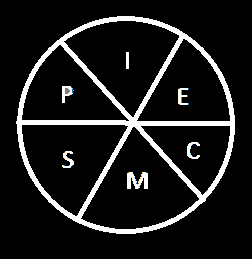
He first drew on the chalkboard (yes, we used chalkboards back then) a circle and then drew three lines through the circle, dividing that circle into six equal sections. In the top three sections he wrote the letters “P”, “I”, and “E” and he filled in the bottom three with “S”, “M”, and “C”, like this:

Mr. Zimmerman went on to explain the meaning of this diagram of his, maintaining that each slice of the “pie” represented a different aspect of our lives and that the slices ought to be all about the same size and that we ought to devote equal attention to each slice.

So, in memory of Mr. Zimmerman, here is what I plan for my slices in 2020:

Physical – Mr. Zimmerman was not really big on the physical fitness aspect of life. He was, after all, a high school English teacher. He did, though, recognize the importance of being physically active and physically engaged. I have a number of physical goals for this coming year. I want to continue running and aim to compete in a half marathon, at least. I also plan to run 700 miles over the course of the year, quite an increase over what I ran in 2019. Who knows, maybe I’ll even take up yoga.

Intellectual – The need to stay focused and not wander randomly is my main intellectual challenge. For 2020, I will keep my reading centered largely on classics which I have heretofore neglected. I will start with Shakespeare’s Henry VI trilogy and Richard III. To those I will add just a few current novels and finish Ron Chernow’s Alexander Hamilton and read Plutarch’s Lives. This past year I read Republic and a few other works by Plato. I would like to follow that up in 2020 with Aristotle’s Nicomachean Ethics, if I can find a translation that makes sense to me.

Emotional – I am a fairly even person emotionally, not out of control on the upside nor the downside. So, for 2020, I guess it will be steady as as (s)he goes. Or, perhaps, what would do me some good would be more emotional involvement in the world around me and, with it, more emotional maturity. Maybe I need to open myself up to experiencing life’s highs and lows more. Laugh more, cry more. More weddings and funerals in 2020?

Social – While I am not a very social person, I am not anti-social, either. I guess you could call me “asocial” if you want to call me anything. As I become more emotionally involved with the world around me, I expect that I will shorten the social distance between myself and others. I know I should want to be more social, but, in reality, I am happy as I am now.

Moral – The more I look at myself, the more I see the need for a more moral me. Morals, after all, are the animating force behind a person’s actions, or at least should be. A more moral me would be a more outraged me and a more compassionate me and a more socially engaged me and a more emotionally charged and mature me. It will begin with a more moral me.

Cultural – I feel that the cultural part of me is the part that presents one of the biggest opportunities for growth. After 2019 slipped by without me being all that culturally active, I have decided to be much more culturally active this coming year than last. Reading plays is one thing, but there is nothing like seeing them performed. I will be taking in a modern re-telling of Richard III, the play Teenage Dick by Mike Lew, which will be at Washington DC’s Woolly Mammoth Theater in June. That should be a nice wrap-up to reading the bard’s plays. I also have a number of other live performances planned. Additionally, I will be expanding upon the limited amount of Italian I learned in 2019 before visiting Rome and Cinque Terre. I am committed to more travel abroad in the future, but for now that is a hope, not a plan.

I am quite sure I have not done justice to Mr. Zimmerman’s “pie” but at least I have a start.

Thank you, Mr. Zimmerman.

Immortality

Read the photo essay (if you can call looking at photographs “reading” them) from Issue 148 of Granta, the Summer Fiction issue, along with the accompanying commentary. The photo essay was on H+, transhumanism, by the multi-talented Matthieu Gafsou. Each photo dealt, in some way, with mechanical and electronic and software augmentation and supplementation of humans. The pictures were mostly stark, cold, clinical. This starkness enhanced the effect of the technology and dampened most real human elements in the shots. In one photo, a rat looks more human than the human technician, who appears to be more of a component of the technology than a person.

Of course, the visuals, along with Daisy Hildyard’s commentary, got me thinking. The aim of transhumanists, generally, is immortality, to live forever. To me, this seems like a totally worthless, empty goal.

First, consider the practicalities of immortality. If you can make the body and the mind durable enough to last forever, you had better not be the only one to do so. To be the sole immortal would be to isolate you from the rest of humanity in unimaginable ways. Unimaginable in that no one would understand you and you would understand no one because neither you nor the rest of humanity could imagine what it is like to be the other.

The opposite situation, where everyone is immortal, would be scarcely better. The person you most detest would be around, forever. There would be no escape. The same would be true for other fates: they would last forever.

Then, of course, there is the absurd conclusion to a life that never ends, outliving the earth itself. (I know, I know, we’ll inhabit other worlds.)

A more subtle problem also arises. Anyone with a moderate understanding of mathematics knows quite well what an inverse relationship is. The relevance of this is that the worth we attach to things, how much we value them, what they really mean to us, is inversely related to how often they occur and how long they last. What if you were to only hear your favorite song one more time in your life? Wouldn’t you listen to it more intensely than ever? And wouldn’t it be memorable? Conversely, if you were going to hear that same song an infinite number of times, the joy of each listening would shrink to zero, and, no matter how many zeros you add end to end, you still have zero. Your very most favorite song would become worthless.

Same for your best friend. In fact, you would have no friends because you would attach zero worth to any time you spent with any of them because, after all, that time you eventually spend with them over the course of eternity would be infinite and the inverse of infinite is: zero.

The only escape from this infinite morass of absurd meaninglessness would be, of course, death. The irony there is that, after spending all one’s energy and time and resources on living forever and, ultimately, missing out on really living at all, one would throw in the towel.

I’m in no rush, but when it’s time for me to go, I’ll just go.

The Fiction of Software

I write software for a living. Throughout a diverse succession of software projects, I have programmed in dozens of different languages on an array of computing platforms. Outside of my work life, I read books, a variety of books, including novels, classics, history, technical and scientific works, biography, philosophy. I also read software, which is not as crazy as it might sound. Sometimes there is some helpful information contained in software that I use and, occasionally, in software that I have written. Most software, of course, does not make for as interesting of reading as does most books. On the other hand, some software is highly entertaining.

Over the years (decades, actually) something has gradually worked its way into my consciousness. I have become aware that software and fiction share many similarities. In fact, in several respects, a short story might resemble a short program more than it might resemble another work of fiction.

The first way in which software resembles fiction is setting. A story has to have some context, some setting. That setting might involve place. It might also have a time aspect to it, when the story occurs. Language might also be a part of the setting. So, too, for software. Software also happens (or executes in the parlance of the computing world) in a setting, a setting both of circumstance and of time. It, too, is written in a language, a language often (but not always) suited to the circumstance and time of its execution. Different programming languages have different nuances which suit them to different types of programming. Regardless of the language or nuance, though, each program occupies some problem space, some domain, and that domain plays a huge role in what happens in the program.

Fiction also has characters. Some of the most memorable fiction has the most memorable characters. Think of some of your favorites. Software is full of characters, too. Those characters are called different things in different programming paradigms, but they are there and each one has, well, it has character. Sometimes these characters are called variables or objects or entities or whatever, but they all have some presence. They all have a role and they all behave in certain ways, although sometimes those ways are obscure and mysterious. Each one is there for some specific purpose, if it is well written software. Sometimes, though, in some not so well written software, just as in some not so well written fiction, there are some useless supernumeraries, extras, entities that tend to obscure rather than clarify the story at hand.

Of course, what would a story be without a plot, a sequence of events that transpire. Ditto for software. Software that does nothing is not really software.

Finally, setting, characters, and plot are all directed toward a purpose, both in fiction and in software. After all, a story must have a point of some sort and not just meander about aimlessly, although some fiction seems to do just that. At the bottom of it all, the function of software and of fiction is resolution of some problem or some conflict, something that needs to be set right. What might be needed is to deliver a message nearly instantaneously or it might be the hero in a novel making sense of her life, whatever. Both have to move a narrative toward a resolution. That’s what software and fiction do.

8618 Addendum

Years ago, when I was much younger, in high school and before that, my mom had this bothersome desire to frequently rearrange the plants in our yard.  Not just bulbs and mums and small manageable plants, but bushes, hedges, and even trees.  Big ones, sometimes.  Of course, fulfillment of these wishes fell on my shoulders.  Literally.

This penchant for moving plants of all sizes continued even after I went off to college and our yard had become her yard (somehow Dad escaped having to participate in all of this and I never found out how he managed that.)  Over time, her plant movings became more ambitious.  On one trip home from college I was handed a shovel and directed to a twenty foot tall pine tree in the back yard that “would look better in front of the house.”

After Mom passed away back in January, I thought that my days of moving Mom’s plants were over.

Silly me.

Before she left us, long before she left us, about fifteen years ago, when Mary, the kids, Rusty, and I lived at 8618, Mom gave us a rose bush which we planted near a front corner of the house.  The bush flourished, to say the least, and, despite trimming by us and the new owners of 8618 after we moved, the outer edge of that rose bush pushed out pretty wide and quite high.  It had become a huge, flowering presence.

That changed, as I witnessed on my walk with Ryan last week, when we saw all the plants trimmed down to almost the ground.  A brief chat with one of the workers on the site informed me that the plants were to be removed completely in short order.  I related the history of the rose bush to him, and without me even needing to ask, he offered to save the rose bush for me.  He warned me, though, that, although he would set the bush aside with his backhoe, it would likely not remain there very long and that the day I saw it, I should take it while I could.

I agreed, happily, and a few days later, as I drove home a bit late from work, I saw the uprooted rose bush and its ball of dirt.

Later that same night, I returned to 8618 and grabbed the plant and its root ball to bring to our house.  I was glad to see that the light rain that day had kept the whole thing damp.    I held it firmly by the base and lifted.

It did not budge.  Not one bit.  I suddenly realized that it outweighed me by a considerable amount.

“She got me, again,” was all I could think.

I eventually knocked enough dirt off the roots so that I could wrestle the rest into the wheelbarrow I had brought with me and which, on the way home seemed to creak as if this would be its last trip.  The bush stub and root ball still weighed about as much as me but somehow I was able to hoist it into the wheelbarrow and deposit it in our current back yard, which will be its final home, I can assure you.

Addendum Postscript: Happened to meet the new owner of 8618, the wife in the wife and husband couple who bought the house from the people who bought the house from us. She said that they bought the house to rebuild and sell and that they would likely not keep any of what was there.

Oh, well.  Time to move on.

Occasion at 8618

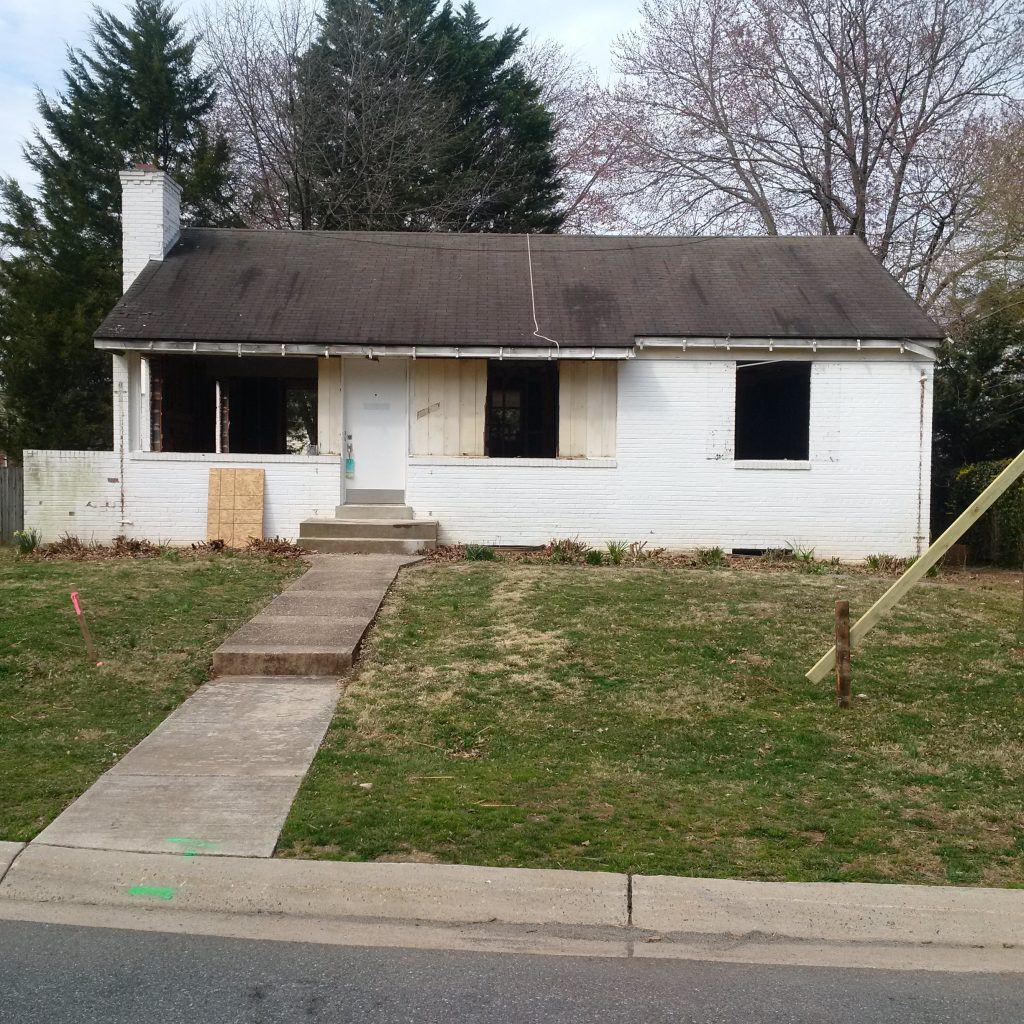
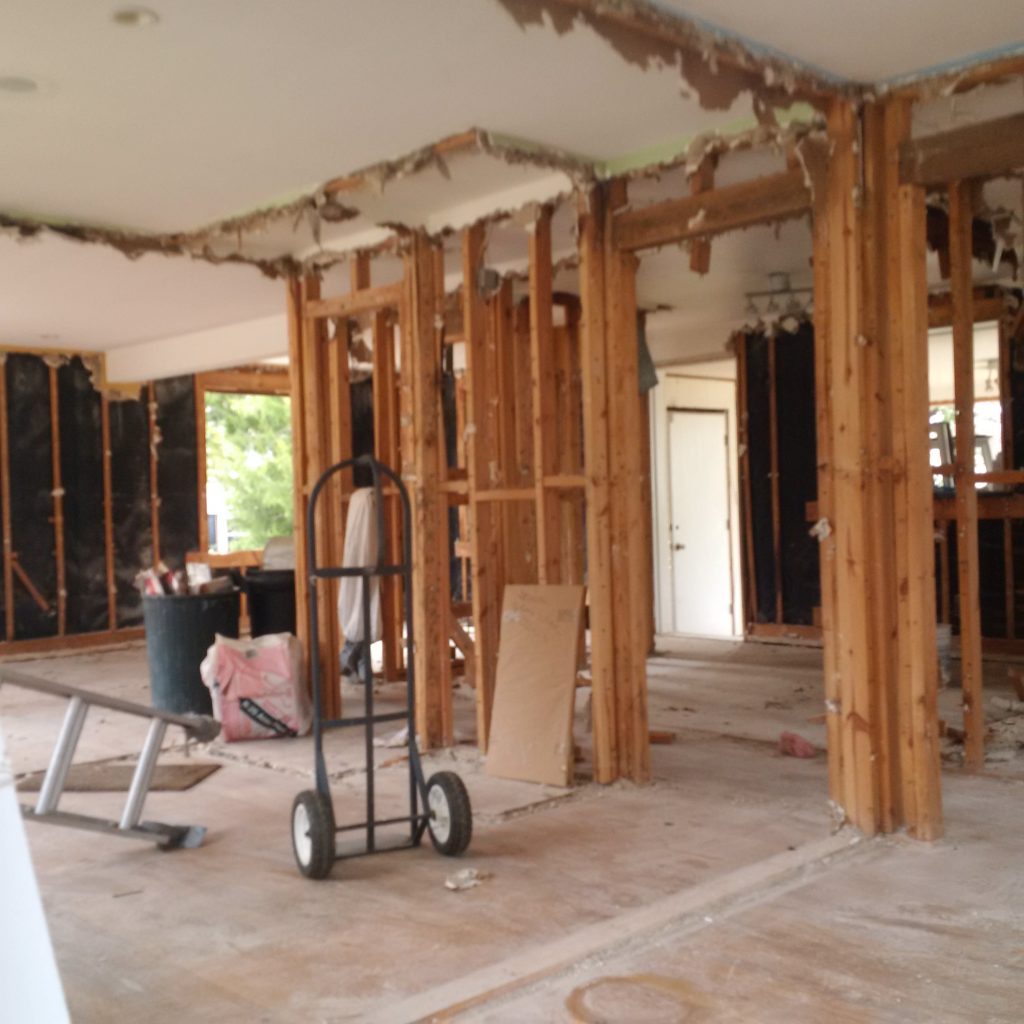
I had occasion today to stop by our old house at 8618, which we moved out of just over ten years ago. The occasion for stopping there was that I was out walking our golden retriever, Ryan, which I do every day, and, in fact, I pretty much walk by our old house every day, since we only moved across the street and just a few houses up the road. This occasion was different, though. While much of the inside of the house had already been surreptitiously gutted in the past week, this morning empty eye sockets stared out mournfully where only yesterday windows had remained. The azaleas and rose bush were cut off just above the ground, as were all the daffodils and whatever else had pushed up in this nascent spring. The shorn plants and the lonely sight of all those windowless gaps pulled me in for a closer inspection. Ryan followed patiently.

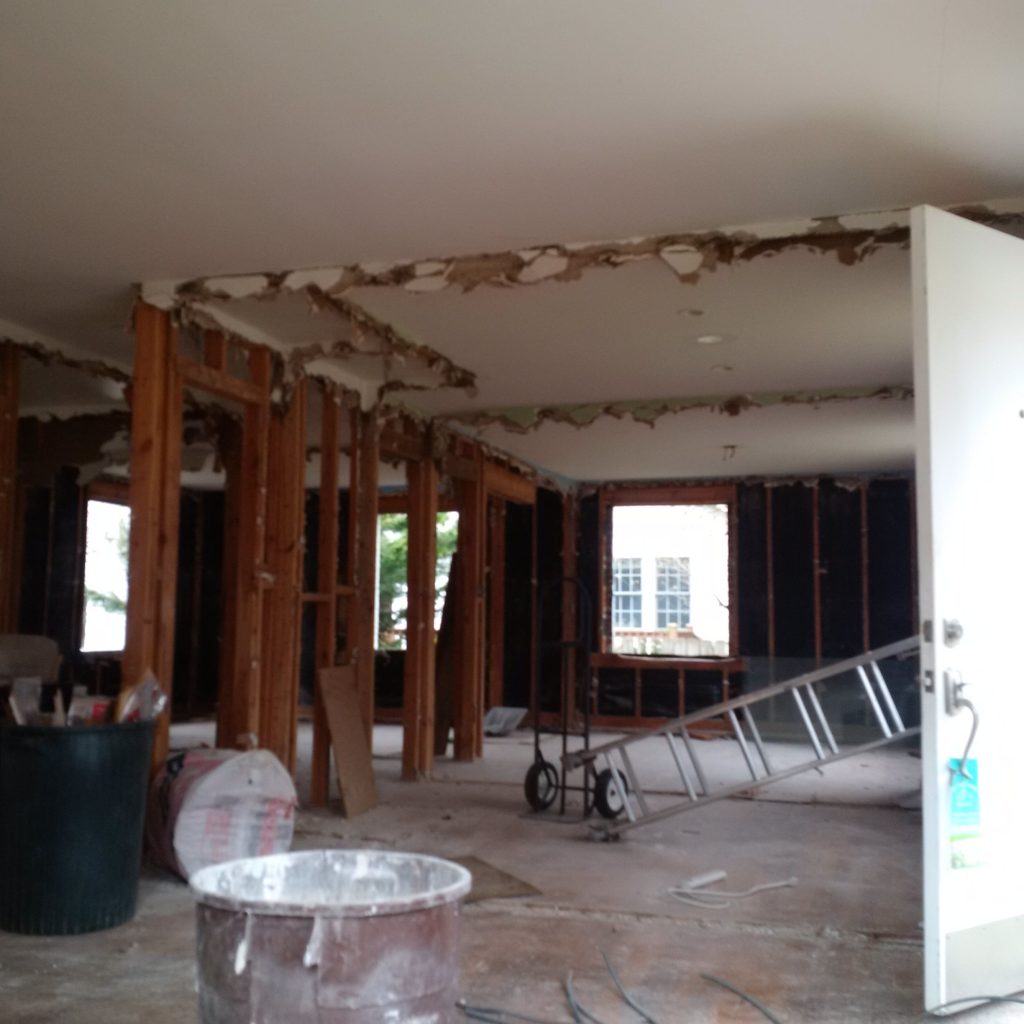
I would have expected the sight of the recently gutted interior of 8618 exposed in that way to have upset me but, strangely, it did not. Sadness did not prevail but instead curiosity took hold of me. I peeked inside, admiring the brick-and-block sturdiness and all the other hidden details, suddenly revealed, which made the house so rock solid. As I peered inside, I noticed that care had been taken to ensure that whatever was not to be removed was left intact and undamaged. The house is not to be torn down but redone on the inside and, perhaps, added to, as well. I felt an unanticipated sense of comfort with the less-than demolition of the house. It was not to be discarded but reborn. The fact that I was comfortable with the change made me smile.

Shorn, Forlorn, About to be Reborn

Contrast that with the fact that, just three houses further down the road is the first house we occupied in this neighborhood, or, I should say was the first house we occupied in this neighborhood. 8612 was torn down to make way for a new, much larger house of far less character. That exchange of houses upset me as it seemed to be nothing more than an attempt to fill as much width and depth and height as the local zoning ordinances would allow. Square footage replaced a warm, welcoming home. Seeing 8612 discarded saddened me.

Now, I associate wonderful memories with each of those two homes. The first we lived in, 8612, was where we lived when Marie was born and where Liam watched through the front door as epically lousy basketball games were played for hours on end in the park across the street. The house even had a name, “The Blue House,” even though the only blue part of the house was the door.

More of Our Old House

8618 held a very special place in the hearts of the whole family. It was the home where we brought Rusty, our first golden retriever, a rescue, from a shelter down in Virginia. Over time, Rusty became so attached to 8618 that after we moved up the street he would try to sneak out of our new house and run away to go back home. It was also the place where Mary and the kids watched out the bedroom window as Dad donned a hooded sweatshirt and a Darth Vader mask to do battle with a nest of hornets and the place where youngsters awoke before dawn on Christmas morning.

Even More of Our Old House

And so it is sometimes with memories that they outlive the places where they happened. 8612 is gone and 8618 is about to have a fresh new life but both of them will live on in our memories.

Despite the fondness of the memories, though, it is tomorrow that really matters, our next step is more important and more interesting than the step before it.

Ryan and I had a walk to finish and that’s just what we did.

Novel Now: Prompt #3

A character arrives late to a party, not knowing that an old significant other is attending too. The relationship didn’t end well. The host introduces them to each other, unaware of their history. In 500 words or less, write the scene and rewrite it twice, once from each character’s perspective: The late arriver, the ex and the host.

Why: Sometimes a story scene can be effective written from a secondary character’s point of view. Writing as a neutral observer might help you notice details worth including in the scene (such as the main characters’ actions and body language); actions that you wouldn’t think about as much if you were writing from a different viewpoint.


Crap!

More than fashionably late and now this.  Lanny introducing me to Stella. Going on and on about her. I could tell Lanny a million things about her, things he would never guess. Things he probably wouldn’t want to know. A whole history book.

Feigning interest and surprise, I’m trying to keep up with Lanny and his gushing over Stella.  Gushing that obviously came from Lanny’s wife, who just recently met Stella and obviously doesn’t know about Stella and me or, if she does, she failed to fill in Lanny on our past.

So, Lanny launches into a colorful, extended, over the top introduction of Stella to me.

The subtext is clear: Stella and I should hook up.

Walking a tightrope, I try to share Lanny’s enthusiasm, but not commit to anything, all the time hoping Lanny will excuse himself to mingle with the other guests.

Stella could help out here a bit, too. Instead of lapping up all this praise, she could set the record straight, or at least demur. She could act a bit embarrassed or ask Lanny to stop but instead she just smiles pertly and almost nudges him on, more, more.

As Lanny moves on to another third- or fourth-hand story about Stella, I want to stop it but realize that this conversation has gone on too far.  At this point I cannot simply break it to Lanny that Stella and I flamed out a couple years ago, ingloriously, irrevocably, and very loudly.  Telling Lanny that in the midst of all his story, complete with bodily re-enactment and sound effects, would slap an awkwardness on us that would probably necessitate either Stella or me or more likely both of us excusing ourselves from the party immediately.

So I grin and bear it.

And glance at Stella, whose eyes are fixed on Lanny.

Lanny puts his arm around my shoulder, gives me a good shake and a squeeze.

Someone, please, help me out of this.


Oh, this is delicious!

Lanny wants to introduce me to Steve. I guess Louise didn’t pass along the Stella/Steve story to Lanny or maybe I just edited Steve out of my past. After all, when I met Louise I didn’t want to open with that gory tale. Just as well left out. It was just nice to not have that messy cloud hanging over every conversation. After a while, I guess it would have been too awkward to delve into it, so I just let it rest. After all, Louise and Lanny didn’t know Steve and I back then, so why bring it up?

And now here comes Steve, late for the party and unprepared for what he’s about to step into.

Thanks, Lanny, for that wonderful introduction.

My, Steve, speechless? That’s a switch.

That’s right, Lanny, keep on going, this is all sounding good. I’ll neither confirm nor deny these glorious stories. Kudos to you or Louise, whoever added all these embellishments. You draw such a delightful picture of me that I hardly recognize myself.

Steve, I can feel you looking at me but you’re on your own, pal. Lanny is too deep into the Stella stories now for you to tell him how well we already know each other and I’ll be damned if I’m going to stop him. He’s on a roll. Stop him? Ha! Eat shit, you little prick! After all those nasty things you said about me? Acting like you were perfect, Mr. Holier-Than-Thou.

No, I’m enjoying this too much.


Ah, there’s Steve, more than fashionably late, but, hey, that’s okey-dokey. Being the great host that I am, I’ll just usher old Stevie over and make the introduction. Stella’s been prepped with the “new friend I’d like you to meet” to whet her appetite and pique her curiosity. From across the room she’ll have a chance to view this guy as I bring him over to her. Piece of cake.

Come on, Steve, over here, there’s someone Louise and I would like you to meet. You’ll love her. Louise has told me some wonderful things about her.

Stella, this is Steve, the guy I was telling you about. Steve, this is Stella.

Steve’s look says it all. Mouth open, at a loss for words. Let’s move this forward.

Louise has told me quite a bit about Stella. An impressive young woman, Steve-o. Let me tell you a bit about her.

Both you guys kind of quiet, huh? That’s okay, I can keep this conversation going until one of your brains kicks in. Stella, you keep your eyes on me and Steve, you keep eyeing Stella and I’ll keep chipping away at the ice. That’s okay, how about another story? There’s plenty more where that came from.

I can do this all night, if that’s how long it takes. After all, I’m game for a challenge. Besides, this is a lot more fun that trying to entertain Louise’s boring friends.

Novel Now: Prompt #2

A character is being chased by a villain or villainous group through an abandoned warehouse. Describe their fear and lucky escape in 500 words or less. Rewrite the piece from the viewpoint of the villain(s).

Why: Rewriting a protagonist’s scenes from the antagonist’s perspective can help you create a more realistic sense of threat, since you will be able to picture the protagonist as well as antagonist’s movements and psychological state clearer.


Lonnie set his two drinks on the floor in front of the passenger seat.  He started the car and carefully pulled it around, parked it between the front door of the jazz club and the cars of Wes and Darron, nestled in an open spot just behind Jones’s SUV.  Slid over into the passenger seat and adjusted the side mirror so that he could see the jazz club door down the sidewalk behind him.  Briefly opened the glovebox and checked inside.

Then he settled in and waited.

While he waited, Lonnie finished off the two double whiskey sours at his feet.  He stewed and he simmered over the situation.  Rage and indignation boiled within him.  Jones was not going to abscond with Lonnie’s players.

In the side mirror, the sight of the club door opening disrupted Lonnie’s thoughts. Lonnie leaned closer to the mirror for a better look.

It was a couple exiting, bundled up and walking with their arms around each other against the chill of the night.  They crossed the street and wandered down the sidewalk the other way.

A minute later, two familiar figures stepped out of the club door.  Lonnie straightened up in his seat.

“Leaving early?  Past your bedtime?” Lonnie sneered to himself.

Darron and Wes walked slowly up the sidewalk, discussing.  Lonnie, hand poised on the door handle, leaned closer to the side mirror until his forehead was touching the window.  His jaw tightened.

Darron and Wes made their way past the alley next to the club and continued past storefronts, closed for the night, dark.  Darron talked animatedly, using his hands.  Wes listened intently, eyes on Darron, and nodded

The two were even with the tail end of Lonnie’s car when he pounced.

Flinging the car door open, Lonnie barked, “Jones!”

The two coaches jumped, startled.  Neither said a word.

Lonnie stepped toward them, face seething, steam rising off his head into the chill of the night.  He stopped a couple paces in front of Darron, arms folded across his chest, lips pursed.  Jones cautiously took a step closer.  He could smell the double whiskey sours on Lonnie’s breath.

Wes stepped up next to his friend.

“What do you got to say for yourself?” Lonnie demanded.

“What are you talking about?” Darron answered, trying to match Lonnie’s indignation.

“I hear you’re walking out and you decided to take a few things along with you.”

“Where’d you hear that?”

”Never mind.”

“Wise tell you that?”

“I said never you mind that!”

“You sure Wise has his story straight?” Jones challenged Lonnie.

“You keep your hands off my players!” Lonnie shouted and jabbed his finger into Darron’s chest.

Darron’s eyes blinked, his jaw tightened, and he brushed Lonnie’s hand away. “You don’t own those boys!”

“I said you keep your hands off my players!”

“And I’ll do what I please!” Darron shouted right back.

Lonnie turned away from Darron and stepped to the open car.

He leaned in and opened the glovebox.

Darron grabbed Wes by the arm and shoved him back toward the club.

“Run for it!” Darron shouted.

As Lonnie straightened up and turned back toward Darron and Wes, he saw the two of them run around the corner and into the alley.  Lonnie took off after them.   He heard the sound of a trash can being kicked halfway down the alley.  They were getting away.  Lonnie’s shoes slapped the pavement as he passed the last storefront and rounded the corner into the alley.  He saw the two men and he shot, wildly.  At the sound of the bullet striking the brick wall, the two instinctively put their hands up behind their heads and ducked as they ran.

“Faster!” Lonnie heard one say to the other.

Lonnie cursed and chided himself, told himself he wasn’t in the movies. On the next shot he would stop and steady himself before shooting.

Darron and Wes raced to the end of the alley and made a sharp cut out of sight.  Lonnie avoided the knocked over trash can, came to the end of the alley, and skidded to a stop as he cleared the corner.  He stopped, raised his gun, and froze.

Two D.C. police officers, guns drawn, told him to drop the gun and put up his hands.  Lonnie, staring down the barrels of the two drawn guns, did as he was told.

The chase was over.

Now Novel Prompt #1

A character is moving to another city. She visits her favourite public place and sees something that makes her want to stay. Describe this in 500 words, using third person POV (he/she). Then rewrite in first person, using ‘I’.

Why: Rewriting third person scenes (especially emotional ones) in first person helps you find your character’s voice.  You’re telling the reader what your character thinks as your character, not an observer. When you rewrite in third person (if you prefer this POV), some of this immediacy will carry over.


Mrs. Jones, the mother of Jeremy Jonathan Jones, Jr. and the wife of J-J Jones, Sr., moved with her son and husband from a small town in western Pennsylvania that nobody ever heard of to Washington, D.C., which everybody heard of.  Decided to visit every monument and museum she could before she got herself too settled in and came to view such things as too “tourist-y.”

Before the family actually packed up and left, however, a certain dread had kept her from really embracing the move.  The voice of the small town girl in her tried to warn her about the dangers of the big city, especially a city where it’s all about power and politics.  And that voice of fear was winning.  She was convinced the move was a mistake.  She worried about what Jeremy would be exposed to in this new, hostile environment.

She went along with the move, but only for J-J Sr’s sake, what with his new job working for the government and all, but she was not going to enjoy it.

Until she did.

The only prior visit she had ever taken to D.C. was when she was in high school, on a school trip, and at the time she could not imagine that there was anything duller in the whole world.  Colonial-this and Civil War-that and the whole place just seemed so in-the-past distant and over and done with.

But that was then.  This time around, with a fresh set of eyes and having a son and a different outlook on the world, so much of all the history and all the culture, and all the different cultures, so much of what she saw meant so much more to her.

“You know,” she told someone about it afterward, “on my high school trip, everything was all planned for us and there was not a whole lot of room for asking questions and I’m a naturally curious, questioning person.  Being able to seek out what I want to see and find out what I want to know, to learn, that has made all the difference.   I like it here.”


I’ll tell you, Jeremy and J-J Sr. were looking forward to moving out here to D.C. but I had my reservations, coming from a small town in western Pennsylvania and all.  That small town girl voice inside my head warned me about Washington and it all being about money and power and the like.  So, yes, I definitely had my reservations, what with the dangers of the city and Jeremy and what he would be exposed to.  I was worried and nervous and filled with a bit of dread,

But I went along with the move, for Sr.’s sake, his new job with the government and the opportunity that presented itself to him.

I wasn’t happy about it but I put on a brave face.

Once we arrived here I thought I would get out and see some of the sights around town before I got too settled in and got to be too much of a local.  It seems like once you live in a place for a while, you never get out and see the things that visitors to your city see, all the attractions and monuments and sights.

I had been here once before, just once, on a class trip with my high school.  That trip was just dreadful.  Everything on that trip was planned and we were rushed along from museum to museum and I could not imagine that there was anything duller in the whole world.  Colonial-this and Civil War-that and the whole place just seemed so in-the-past distant and over and done with.  There was no opportunity to see anything that I might really want to see, just follow the schedule and make sure to keep up.

This time around, though, I was left to my own devices and you know, I was fascinated by what there was to see, really fascinated. Some of the museums show some of the contributions that all the different people, all the different types of people, from different backgrounds and all, made to our country.  I had no idea.

The more I saw, the more I was amazed.  There’s so much history and culture and even Jeremy was hooked after a while.

I’m glad we moved here.